
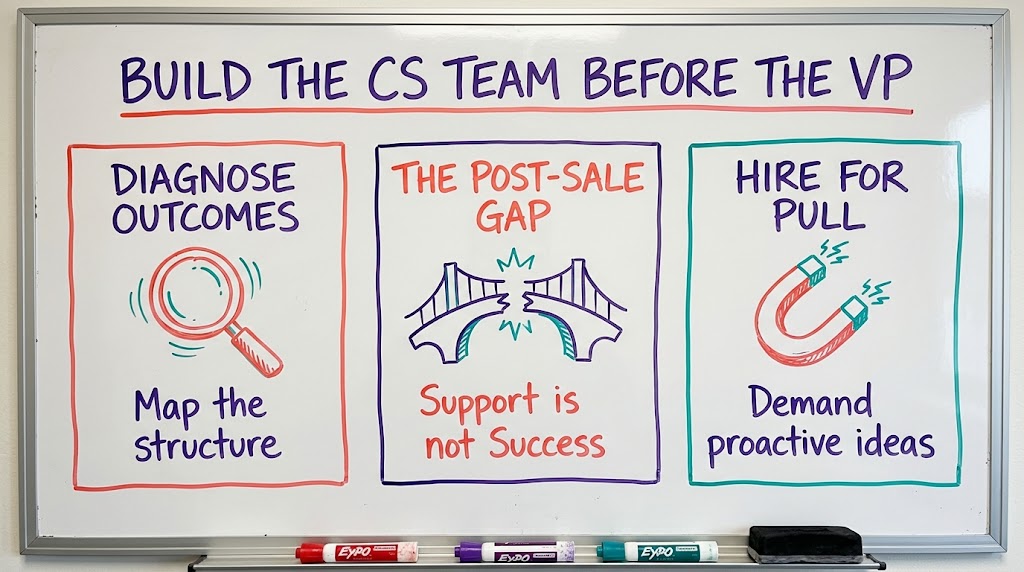
Build the CS Team Before the VP
Hiring a VP of Customer Success before you have a real CS function rarely works. Here's what our mastermind founders recommend doing first: define the outcome, design the structure, and hire people who pull you forward.

One of the most useful conversations in our mastermind recently started with a simple question. A founder running a product-led SaaS company wanted advice on hiring a VP of Customer Success. He had tried three times over the past three years, and none of the hires had worked out. This time he was talking with a recruiting firm that wanted 25% of first-year on-target earnings, capped at a $200,000 salary, so up to about $50,000 for the placement. He wanted to know if that was normal and how others had hired for the role.
By the end of the call, the group had pushed him toward a different question. The bigger issue turned out to be whether he was hiring for the right role at all.
The team behind the title
When the group asked about his current setup, the picture got clearer. He has about 30 people across customer-facing roles: roughly 8 on an onboarding team and around 22 in customer support covering chat, email, and live Zoom. His support is excellent. Paid customers can join a live Zoom between 9am and 8pm and get help with essentially zero wait. The onboarding team converts 65% to 70% of trial users who go through onboarding into paying customers.
But there's a gap in the middle. Onboarding reps are heavily incentivized on trial-to-paid conversion, so they act more like salespeople. Once a customer converts, nobody follows up proactively, tracks feature adoption, or checks in each month. He has a passive fractional person reporting to him and no true CSMs. As one founder put it bluntly: you don't need a VP of Customer Success yet, because you don't have a customer success function.
- Strong support isn't customer success. Being great at reacting to problems doesn't mean anyone is working to prevent churn.
- Onboarding tied to conversion acts like sales. Reps paid on trial-to-paid will optimize for the close, not for long-term health.
- The post-sale gap is the real problem. The space between "just converted" and "renewing" has no owner.
- A VP needs something to lead. Without a team, a structure, and targets, a senior hire walks into an empty room.
The recruiting firm said the same thing as soon as they read his job description. A VP of Customer Success role doesn't make sense when there isn't a single CSM on the team yet.

Define the outcome before you hire
The most consistent advice from the group was to slow down the hiring and speed up the diagnosis. One founder suggested talking with a few experienced people on LinkedIn, not to recruit them, but just to understand the problem better. Then bring in someone fractional for a month or two whose first deliverable is a recommendation: what structure you need, which roles, what targets, and in what order.
Another founder suggested framing the question around a single metric. If you could only pay this person to move one number, what would it be? For this founder, the lagging measure is net revenue retention, with leading indicators underneath it. He compared it to going to the gym: the goal is weight loss, but what you track is how many days you go and how often you eat well. Put that metric in the job description, and consider a short paid trial where the candidate works with 5 or 10 customers to show they can move it.
- Start with a diagnosis. Pay someone experienced to tell you what structure you need before hiring to fill it.
- Name the primary metric. For most CS leaders that's NRR or GRR, with clear leading indicators underneath.
- Use a trial project. Two weeks to a month on a small set of accounts reveals more than a dozen interviews.
- Consider a fractional CRO. Several founders thought the real gap was revenue architecture across the whole funnel, which a strong fractional CRO could map.
One founder made a sharp point about the full funnel. Fixing what happens after conversion depends on what happens before it. If onboarding reps over-promise to hit their conversion targets, customers will churn later no matter how good the CSMs are. Someone needs to look at the whole journey: which channels customers come from, which ads, which rep they talked to, and which ones stick around. The goal is healthy revenue that grows, not vanity revenue that's gone in six months.
Hire for pull, not push
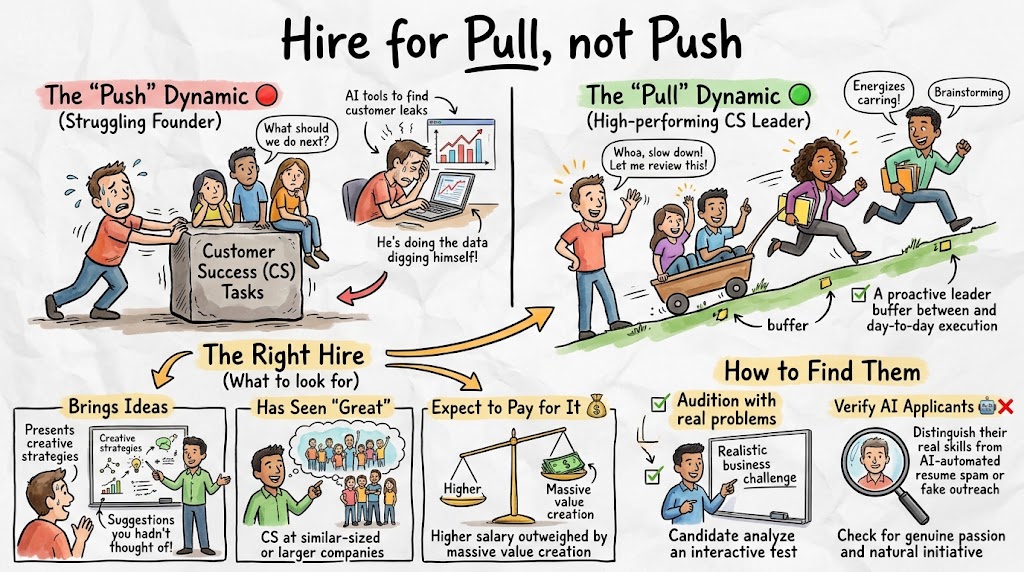
The founder said something that stuck with me. On his marketing team, he constantly has to tell people to slow down because they're doing too much. On the customer success side, he's always the one pushing, asking the team to grade onboarding calls, look at the data, or try something new. He spent an hour the day before the call digging into his own data with an AI tool to find where customers were leaking. He knows that time should belong to someone else.
Another founder described this as the push versus pull dynamic. He wants his direct reports to feel like he's slowing them down, not the other way around. At this founder's size and stage, he shouldn't be directing a CS leader task by task. He should be defining an outcome and having that person figure it out and come back with a plan.
- Look for someone who brings ideas. The right hire shows up with suggestions you hadn't thought of.
- Find someone who has seen what great looks like. A person who has run CS at a similar-sized or larger company can bring that pattern in.
- Expect to pay for it. You'll likely pay more than you'd like, but the right person will create far more value than they cost.
- Interview hard and audition. Get referrals, interview thoroughly, and give them a real problem to solve before committing.
The founder lit up when another member described this kind of hire as someone who sits between him and the tactical team, comes back each week with what worked and what didn't, and brings new ideas to the table. That role is what he's been missing. One quick caution came up in the hiring discussion too: with AI agents now sending applications and outreach on people's behalf, verify that a candidate's initiative is really theirs.
Pay CS differently than sales
The group also compared compensation. One founder's CSMs carry net revenue retention targets for their own portfolio of accounts, with a high base and a smaller variable component, somewhere around 70/30 or 80/20, plus a few kickers. That's very different from sales comp, where this founder pays reps a percentage of new ARR, higher for outbound than inbound, with something closer to a 50/50 or 60/40 split.
A founder from our enterprise group shared a related lesson from the other direction. His company spent four years trying to find customer success people who were great at keeping customers happy and could also sell expansion. They rarely found both in one person. Good problem-solvers would hesitate to pitch a new product while a customer had an open issue. His view is that a complaint is often the best time to pitch, once you've solved it.
- Pay CS mostly on base, with NRR upside. CS rewards steady relationship work, not big swings.
- Don't expect one person to do it all. Keepers and hunters are usually different people.
- Consider sales overlays. That founder now has a salesperson join an account to sell new products while the account manager keeps the relationship, and he'll gladly pay both commissions for the extra business.
- Reward the behavior you want. Another founder ties his onboarding team's bonus to time-to-install, since faster go-lives drive retention.
Start customer success on day one
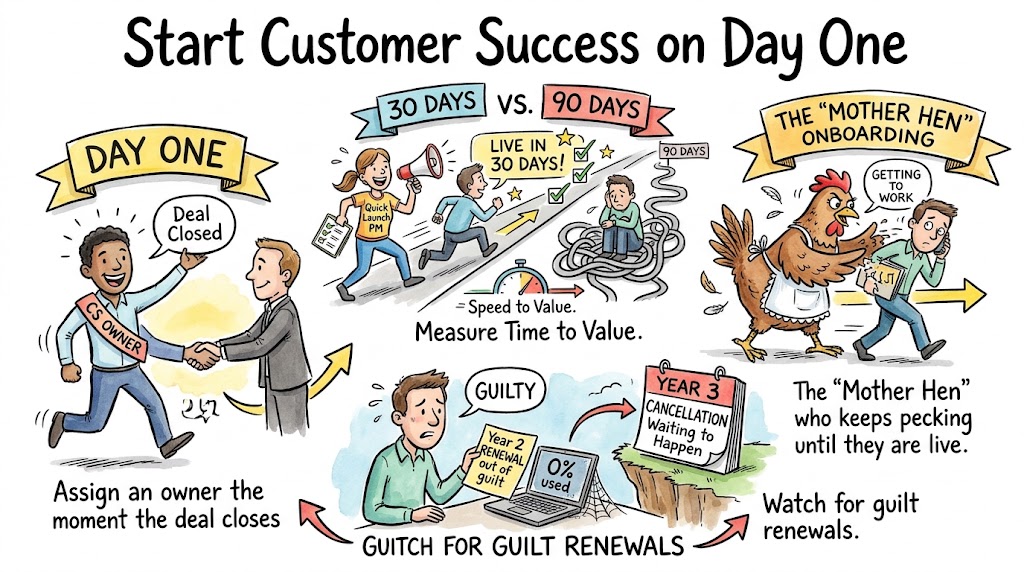
One founder in our enterprise group showed what proactive customer success looks like in practice, even without a big CS org. His company noticed a painful pattern: customers would renew for a second year out of guilt, never having fully implemented the software, and then cancel in year three. The software wasn't failing. The customers simply never got around to using it.
So his team started bundling a quick launch into larger packages. Someone who has done many implementations spends roughly 48 hours with a new customer, acting like a project manager to get their first process live with the right decisions made up front. The goal is to have customers live within 30 days, where a slow implementation used to take 90. He called the role a glorified customer success manager, a mother hen who keeps pecking until the customer is up and running, and it has improved retention.
- Assign an owner the moment the deal closes. Don't wait for a customer to struggle before someone checks in.
- Measure time to value. A clear target, like live in 30 days, gives the team something concrete to hit.
- Watch for guilt renewals. A customer who renews without using the product is a cancellation waiting to happen.
That's the kind of proactive work a real CS team does, and it's what a future VP should be building on.
Get the order right
If you're thinking about hiring a VP of Customer Success, it's worth asking what you're really trying to fix. If the answer is that customers convert well but nobody owns them afterward, the first step probably isn't a VP. It's defining the outcome you want, getting expert help designing the structure, building a small team of real CSMs, and measuring them on retention. Then, once there's something to lead, hire the leader who will push you instead of the other way around. Build the team first. The VP comes after.