
Code Isn't a Moat: What Is Now?
When anyone can rebuild your software in weeks, the code itself stops protecting you. Here are the moats SaaS founders in our mastermind are building instead: data, distribution, speed, and real customer value.

Ten years ago, it was hard to write code. Just being in business with a brand, a website, a working software product, and five, ten, or fifteen developers was a moat. A competitor or a customer who wanted to replicate what you'd built faced months or years of work and a lot of money, so most of them didn't try.
That's gone now. In a recent mastermind session I told the group my honest estimate: someone can probably replicate your product in a bad way in about two weeks, and in a good way in about four or five months. One founder had just seen it happen from both directions. His team replaced a vendor in a week with an AI-built tool, and then one of his biggest customers replaced his product the same way. So the question on everyone's mind was simple. If code isn't the moat, what is?
The new moats
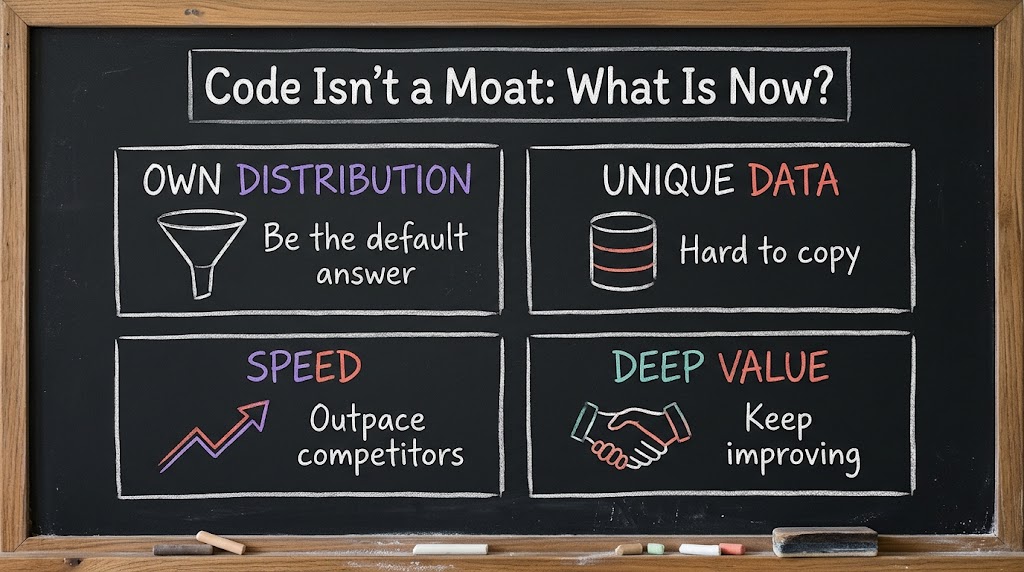
Here's the list I shared with the group, and it's the one I keep coming back to in my own businesses. We need moats based on distribution, brand, partnerships, and unique data. Then, on top of those, we need to use AI in our own R&D so we can speed up our roadmap and build faster than any competitor.
Each one of these does a different job. Some protect you from a customer deciding to build their own version. Others protect you from a competitor cloning your features and undercutting on price. You probably need more than one.
- Distribution. Owning the channels where your buyers find solutions, so you're the default answer when they look.
- Brand. Being the name people trust in your category, which matters more when there are ten look-alike products.
- Partnerships. Integrations and channel relationships that take time and trust to build and are hard to copy.
- Unique data. Information your customers can't get anywhere else and can't generate on their own.
- AI-powered R&D. Using the same tools your competitors have, but shipping faster and better than they do.
The rest of this post goes through what founders in the group are actually doing on each of these.

Proprietary data is the strongest wall
The clearest example came from a founder who has spent almost 30 years in his data sector. His company combines software with proprietary data that customers can't get anywhere else, and he said that's what keeps the product sticky. His customers are in finance, insurance, and corporate security, fighting fraud. Fraudsters keep inventing new ways to get the money, so his team keeps generating new data to solve the next problem.
I asked him what he does as CEO to keep that data top-class, and his answer was about focus. He stays close to what the market needs data-wise, watches the problems customers are trying to solve right now, and builds the data to solve them. Another founder, who just acquired a company in the meeting analytics space, agreed that data looks like the highest-quality moat, especially data you can only get by doing something unique for a niche industry.
- Data a customer can't create themselves. If the value lives in the data and not just the interface, rebuilding the interface doesn't help them.
- Data that keeps moving. A data set that updates as the market changes, like new fraud patterns, is much harder to copy than a static one.
- Niche data is the easiest place to start. Serving one industry deeply often produces information nobody else has collected.
- The CEO owns the data strategy. Keeping it ahead of the market is a leadership job.
If you don't have a data moat today, it's worth asking what data your product already touches that could become one.
Distribution is shifting under our feet
The second big theme was distribution, and one founder shared something I found genuinely new. His team published a plugin for ChatGPT and a connector in Claude's library. When people ask those AI tools how to do something, the tools surface available plugins, and sometimes Claude suggests one on its own. He's now seeing about 8 to 10 plugin or connector downloads every week, and he thinks these libraries are becoming a kind of marketplace with more transaction volume than the traditional cloud marketplaces.
At the same time, a fair point came up. One founder asked: if customers are just going to build their own software, who are you even distributing to? It's a worst-case question, but a good one. Being the fastest and the best-known doesn't help much if the demand side shrinks. The answer from the group was to look at which buyers are least likely to build.
- Show up where AI recommends tools. Plugin and connector libraries are a new front door, and it's early enough to get in ahead of competitors.
- Target buyers who won't build. One founder started reaching non-tech companies like universities, real estate firms, and breweries through YouTube, influencers, and inbound, and his weekly sign-ups roughly doubled from 30 to 35 to almost 75.
- Watch conversion, not just volume. That same founder is still only converting 15% to 25% of sign-ups, so new channels bring their own work.
- Niche focus helps AI find you. Another founder noticed AI platforms recommending his product for specific manufacturing problems, simply because his messaging was so focused.

Speed is a moat if you actually use it
Another founder described a big transition. At the start of the year his team did nothing with AI. Now, he said, nobody on the team has written code by hand in over a month. One engineer who has been with him four years expected to clear his entire backlog of tickets by the end of the week, and the team has roughly doubled the platform's functionality in a year.
That kind of speed is exactly what I meant by using AI in your own R&D. If your competitors can now copy you faster, the response is to move faster than they can copy. But speed brings a new problem. The same founder said his platform is becoming a big, complex thing, which is great for customers who need that, but it's hard to explain in a LinkedIn post or a cold email.
- Use AI internally first. The teams getting the most from AI are rebuilding their own development process around it.
- Clear the backlog, then pick a direction. Once the old tickets are gone, someone has to decide what's worth building next.
- Plan how you'll explain new features. More features don't help if customers never hear about them.
- Be thoughtful about what you broadcast. A couple of founders are now careful about showing detailed roadmaps publicly, since a competitor can hand that to an AI tool.
For communicating new features to existing customers, I suggested a few channels: video retargeting ads aimed at your customer base, trade shows, in-app tours, product emails, CSM outreach, QBRs, and even direct mail. Spending about 52 cents on a postcard to a customer is sometimes the most effective message you'll send all year.
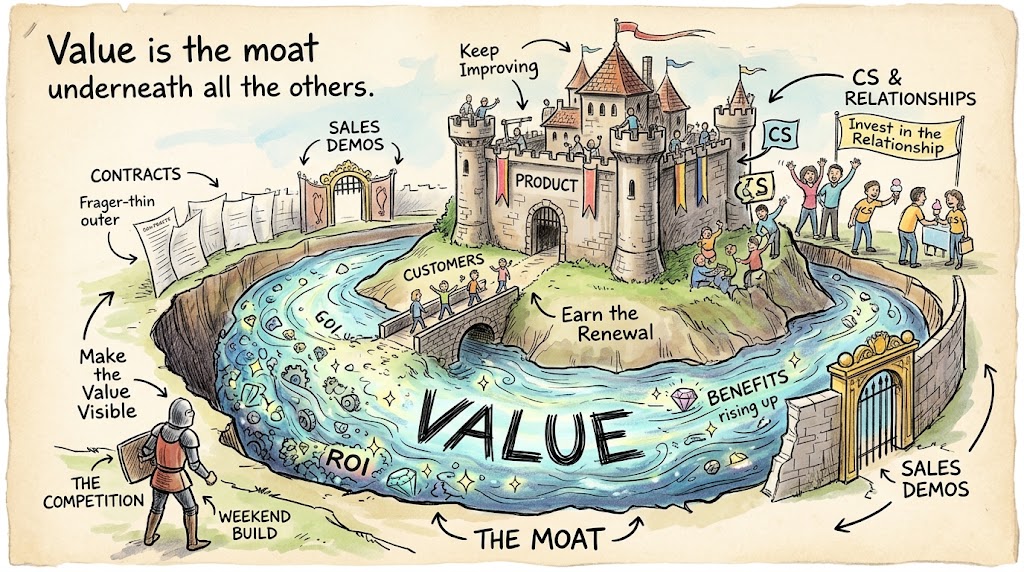
Value is the moat underneath all the others
The last point may be the most important. One founder came at this from a customer-first angle. His view was that building is very different from maintaining and improving, and if you create real, differentiated value, keep improving every month, deliver more than you cost, and make sure customers know it, you lower the odds they ever start thinking about replacing you.
I agree with him. We can't keep enterprise products hidden behind sales demos and locked into multi-year contracts unless we're really delivering value. Another founder added that, in his experience, customer success itself can become a moat. At a prior company, the CS team was the backbone of retention, down to small touches like sending customers ice cream on a hot day. Being there when customers need you is very hard to replicate with a weekend build.
- Make the value visible. Customers should be able to see what you did for them this month without asking.
- Keep improving. A product that gets better every month is harder to replace than one that stood still.
- Invest in the relationship. Support and customer success are part of the product now.
- Earn the renewal. Contracts slow churn down, but only value keeps customers for the long run.
Pick your moats on purpose
I think the next four or five years are going to be tumultuous for software companies. The founders who come through it well will be the ones who stop assuming their code protects them and choose their moats deliberately. Pick the two or three that fit your business best, whether that's proprietary data, owning a distribution channel, deep niche focus, or simply outbuilding everyone with AI, and invest in them like your company depends on it. It probably does.