
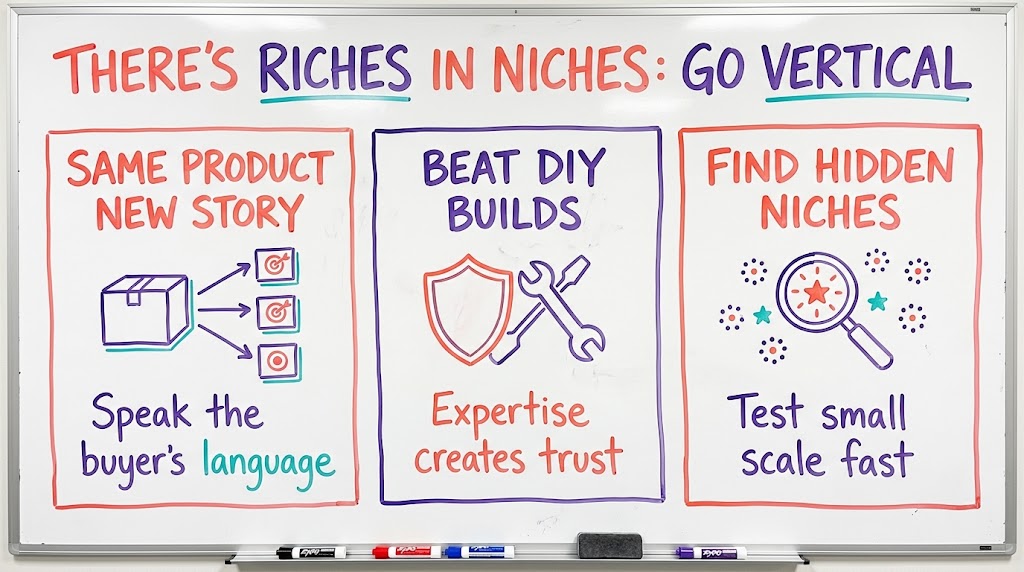
There's Riches in Niches: Go Vertical
A horizontal product doesn't need horizontal messaging. Founders in our mastermind are closing more deals by speaking to one industry's specific problems, and AI makes vertical marketing cheaper than ever.

At a recent session of our enterprise mastermind, one founder shared what he called a great petri dish. His company sells a horizontal workflow platform, and for years they've marketed it that way. This year they spun off a version aimed 100% at manufacturing, with its own website and messaging built around a handful of specific problems that the industry's long-time vendors have never solved well. Same underlying product, very different story.
The results have been striking. The vertical spinoff is pulling people into the funnel more easily than the horizontal brand, and it's closing about 25% of the deals that come through. In a year where a lot of founders in the room were struggling to fill their pipeline, that got everyone's attention. As he put it, it goes back to the old line: there's riches in niches.
Horizontal product, vertical message
The key insight is that you don't have to rebuild your product to go vertical. He kept the platform the same and changed how it's described. The spinoff talks about manufacturing problems in manufacturing language, and buyers no longer have to translate a general-purpose tool into their own world.
He pointed out that a lot of software companies, especially in categories like document management, still sell horizontal solutions and expect the customer to figure out how to apply them to a vertical problem. That worked when buyers had fewer options. Now people shop differently. They search for a solution to their specific problem, and the vendor who names that problem wins the first conversation.
- Keep one product. Vertical messaging doesn't require a new codebase, just a sharper story for each market.
- Describe the problem in the buyer's words. Lead with the specific pain an industry feels, not your feature list.
- Pick problems others have failed at. The most powerful niches are the ones where incumbents have been serving the industry for decades without solving the hard part.
- Brand it slightly differently. A separate site and name for a vertical can make the fit obvious at first glance.
Another founder in the room was already doing this without quite naming it. His platform is horizontal, but nearly all his messaging speaks to the problems of particular industries, mainly agriculture and manufacturing. He said about 80% of his new growth comes from people who used his product at one company, moved to another company in a similar industry, saw people still doing things on paper, and reached out. Vertical focus makes that kind of word of mouth travel further, because the next employer usually has the same problems.

Problem-led messaging gets around the AI question
There was a second benefit that I didn't expect. The founder with the manufacturing spinoff said that when you message a specific problem, you bypass the AI question for a lot of buyers. A prospect who's wondering whether they could just build something with AI is much less likely to go down that road when you've shown them you already understand a niche problem nobody else has solved.
He's also seeing AI platforms recommend his product for a particular set of manufacturing problems. He didn't work at that directly. It happened because the messaging was so focused that the AI tools could clearly connect his product to those problems. That's a big deal, because more and more buyers start their research by asking an AI assistant what to use.
- Specific problems beat general capabilities. Buyers trust a vendor who clearly knows their world.
- Niche expertise weakens the build-it-ourselves impulse. It's harder to imagine rebuilding deep industry knowledge over a weekend.
- AI tools reward clarity. When your positioning is focused, AI assistants are more likely to recommend you for the right questions.
- Your site becomes the proof. A vertical site full of industry-specific language does a lot of the selling before the first call.
Find the niches you didn't know you had
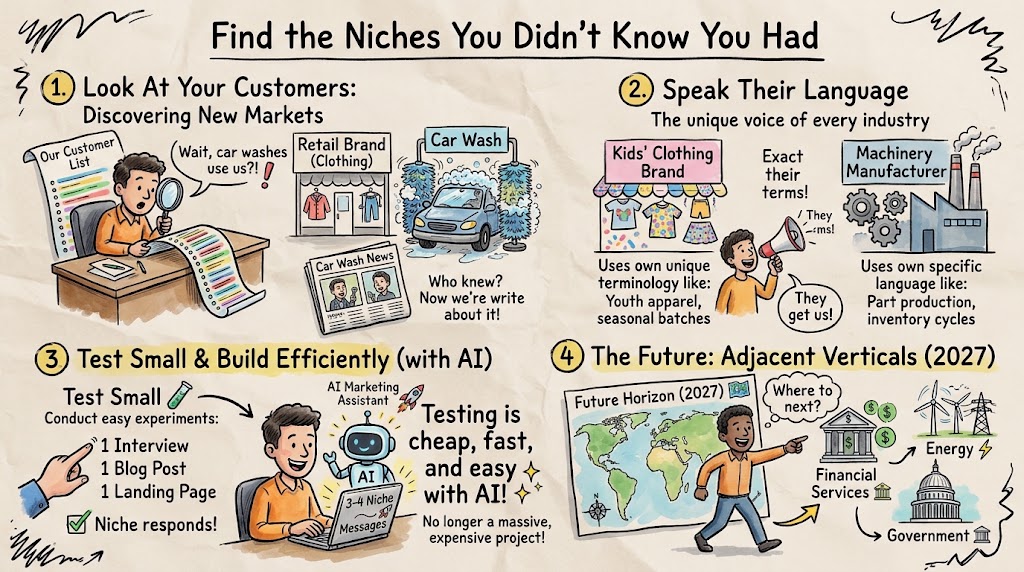
One founder, who runs referral and loyalty software for retail brands, shared a funny discovery. He had just done an interview with a car wash publication because his product, it turns out, works for car washes. He'd never thought of it. Now he's writing a post on how to launch a referral program for car washes and looking for more industries like that.
The manufacturing founder gave him a useful tip. Every industry, and every sub-segment within it, is convinced it's unique. So even inside retail, a kids' clothing brand probably describes its business in a way no other retailer does. If you find that language and pitch your solution in it, you sound like you were built for them.
- Look at who already buys from you. Your current customer list probably includes industries you've never marketed to.
- Listen for how they describe themselves. Use the exact words a segment uses for its own business.
- Test small. One interview, one post, or one landing page is enough to see if a niche responds.
- Expand to adjacent verticals. The manufacturing founder is now asking whether to do the same for financial services, energy, and government in 2027.
What makes this realistic for smaller teams is cost. Building a new website and marketing materials for a vertical used to be a real project. With AI, it's much cheaper and much faster, so testing three or four niche messages is within reach for almost any SaaS company.
Build search authority one niche at a time
The same group had a related conversation about SEO, and it connects directly to going vertical. I shared that we built an automated news system on the SaasRise site this summer, using a news API, a database, and inexpensive AI inference to publish about 10 SaaS news and deal articles a day. Our Google clicks went from about 528 in May to about 2,500 month to date, roughly a 5x increase.
The lesson behind that number came from an earlier mistake. In a previous project I ramped to about a thousand AI-written articles a day across 120 different tech topics, and Google essentially delisted us. We scaled too many topics and too many pages too soon, and Google couldn't figure out what the site was about. On a domain that's been around three years and is clearly about one topic, 10 articles a day looks legitimate, and it worked.
- Own one specific term. Your content should be about the exact topic you want your domain associated with.
- Don't spread across too many topics. Too many subjects at once confuses search engines about who you are.
- Engagement matters more than authorship. Google mostly cares whether people stay on the page and don't bounce back within five or six seconds, not whether AI wrote it.
- More output, more traffic. Most companies post once a week. If you can triple that with quality content in your niche, you'll probably triple your organic traffic.
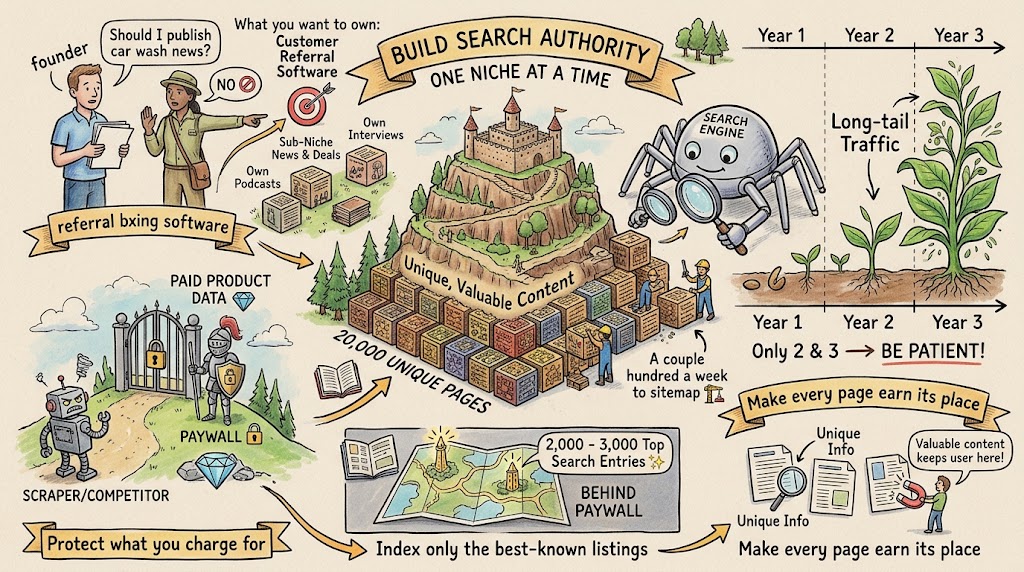
When the referral software founder asked whether he should publish news about the car wash industry, my answer was no. The content should be about the term you want to own, which for him is customer referral software. A few automated articles a month on deals, trade shows, and news in that sub-niche, plus coverage of his own podcasts and interviews, will build authority where it counts.
The same approach works for directories and other programmatic pages, which another founder asked about. My advice was to make sure every page carries unique, valuable content, so no page looks thin to a search engine. If you can roll out 10,000 or 20,000 unique pages over time, adding a couple hundred a week to your sitemap, you can build strong long-tail traffic. Just be patient, since good SEO results usually show up in year two or three.
- Protect what you charge for. If your data is a paid product, make sure the public version can't be easily scraped and turned into a competitor.
- Index only the best-known listings. Put the 2,000 or 3,000 entries people actually search for in your sitemap and keep the rest behind the paywall.
- Make every page earn its place. Each page needs unique content that brings a real user in and keeps them there.
There's riches in niches
The founders in this conversation weren't changing products or starting new companies. They were choosing to speak to one industry at a time, about the problems that industry actually has. That choice is bringing in better leads, closing more deals, getting their products recommended by AI tools, and making their marketing less generic. If your pipeline feels soft this year, take your best-fit industry, find the problem nobody else solves well, and build one page that speaks only to them. You may find, like the founder who stumbled onto car washes, that you've had riches in niches all along.